Zalakaros 2026: Zalakaros Spa, thermal water and parking
 27. 10. 2026.
 Zalakaros parking zones and hourly rates
Zalakaros is located in the southeastern part of Zala County, between Keszthely and Nagykanizsa. As a spa town, it is best known for the Zalakaros Spa: if you are planning a trip to relax or enjoy a spa treatment, it is worth getting to know the town better.
The history of the spa began with water discovered during a hydrocarbon exploration drilling operation, but Zalakaros’s past goes back much further. Alongside your visit to the spa, you can also read a few interesting facts about the town’s history. If you are arriving by car, it is worth checking the parking rules in advance: parking fees apply in the town’s paid parking zone on weekends and public holidays too.
The Zalakaros Spa: the town’s best-known destination
Tourism in Zalakaros is closely tied to its thermal spa. After the medicinal spa opened, organised development began in the town, and plans were drawn up to develop and organise the resort area. If you are wondering what made Zalakaros a spa town, the spa’s history is a good place to start: it also played a decisive role in the town’s subsequent development.
The Zalakaros Spa is an internationally renowned medicinal spa. Since it opened, it has welcomed many visitors seeking relaxation and healing, and the town remained a major tourist centre after the political transition. Today, Zalakaros is a member of the Hungarian Spa Towns Association. If you are arriving by car, as well as planning your visit to the spa, remember to pay for parking for the duration of your stay in the paid parking zone.
How was Zalakaros’s medicinal water discovered?
Zalakaros’s medicinal water was discovered during a hydrocarbon exploration drilling operation. The medicinal spa opened following the discovery, giving the town’s development a new direction: tourism began to take off, and separate plans were later drawn up for the development of the town and its resort area. The discovery of the water is therefore important in Zalakaros’s history not only because it led to the creation of the spa, but also because it influenced the town’s further development.
The medicinal water rises from deep underground and is considered one of the most significant medicinal waters because of its composition and the size of the water reserve. The spa’s thermal water is produced by wells drilled into the upper Pannonian layer, which is different from the source of the medicinal water. If you are interested in what lies behind the town’s reputation as a spa destination, it is worth distinguishing between medicinal water and thermal water: both are part of what makes the Zalakaros Spa what it is.
The composition and significance of the medicinal water
Zalakaros’s medicinal water is alkaline-chloride and bicarbonate in composition. It also contains iodine, bromine, sulphur and fluorine; the presence of these elements together gives the water a composition unique in Europe. Other components of the water include potassium, sodium, magnesium, iron and manganese. The spa’s reputation is therefore linked not only to the discovery of thermal water, but also to the distinctive composition of its medicinal water.
The medicinal water helps, among other things, with the treatment of musculoskeletal, dermatological and chronic gynaecological complaints, and is also used for periodontal disease and the aftercare of certain musculoskeletal conditions. The spa’s thermal water is sodium chloride and bicarbonate in composition. Whether you come to Zalakaros to relax or because you are interested in its medicinal water, the properties of the local waters say a great deal about why the spa has become such an important place in the town.
Zalakaros’s past before the spa opened
Zalakaros’s history is much older than that of its spa. The settlement was first mentioned in the Middle Ages under the name Korus. At that time, Hungarian-speaking castle servants lived in the village, and later King Béla IV’s wife brought foreign settlers there. A church was also built in the village during the Middle Ages. These historical events depict a Zalakaros whose life was not yet connected to the spa or tourism.
The Ottoman period brought severe hardship to the people who lived here. Their crops were tithed both by the Ottomans and by the border fortress soldiers serving at Kanizsa Castle, as a result of which the population was almost completely depleted. If you are curious about the past of today’s resort town, this period marks a particularly stark change: long before its development as a spa town, the settlement had to face serious difficulties.
From market town to tourist centre
Zalakaros was referred to as a market town in the 18th century. However, modest development only began after the surrounding marshes were drained, a process associated primarily with the construction of the Southern Railway. In time, the settlement was also connected to the transport network by intercity bus services, and a local post office was built. After the Second World War, however, people began to move away, mainly to the industrialising town of Nagykanizsa.
The opening of the medicinal spa brought another turning point: tourism linked to the spa also gave momentum to Zalakaros’s development. The settlement later gained large-village status and then town status. Its history clearly shows that today’s resort town is the result of more than a single change: transport links, migration, the discovery of medicinal water and the development organised around the spa all helped shape it.
On the way to Zalakaros: location and getting there
Zalakaros is located in the Zalaapáti Ridge area, between Keszthely and Nagykanizsa. The easiest way to get there by car is via the road running between Galambok and Zalaapáti, but a secondary road also connects it to Zalakomár. Route 7 runs south of the town, with the M7 motorway farther south; it has an exit for Zalakaros–Zalakomár. If you are driving to the spa, you can plan your route based on these roads.
The town also has a bus station, which plays an important role primarily in long-distance transport. Services arrive from, among other places, Budapest, Hévíz, Keszthely, Nagykanizsa, Veszprém and Zalaegerszeg. The town’s location is therefore worth bearing in mind when planning a journey by car or bus. If you are arriving by car, check the local parking arrangements as well as your route before you park.
Parking in Zalakaros
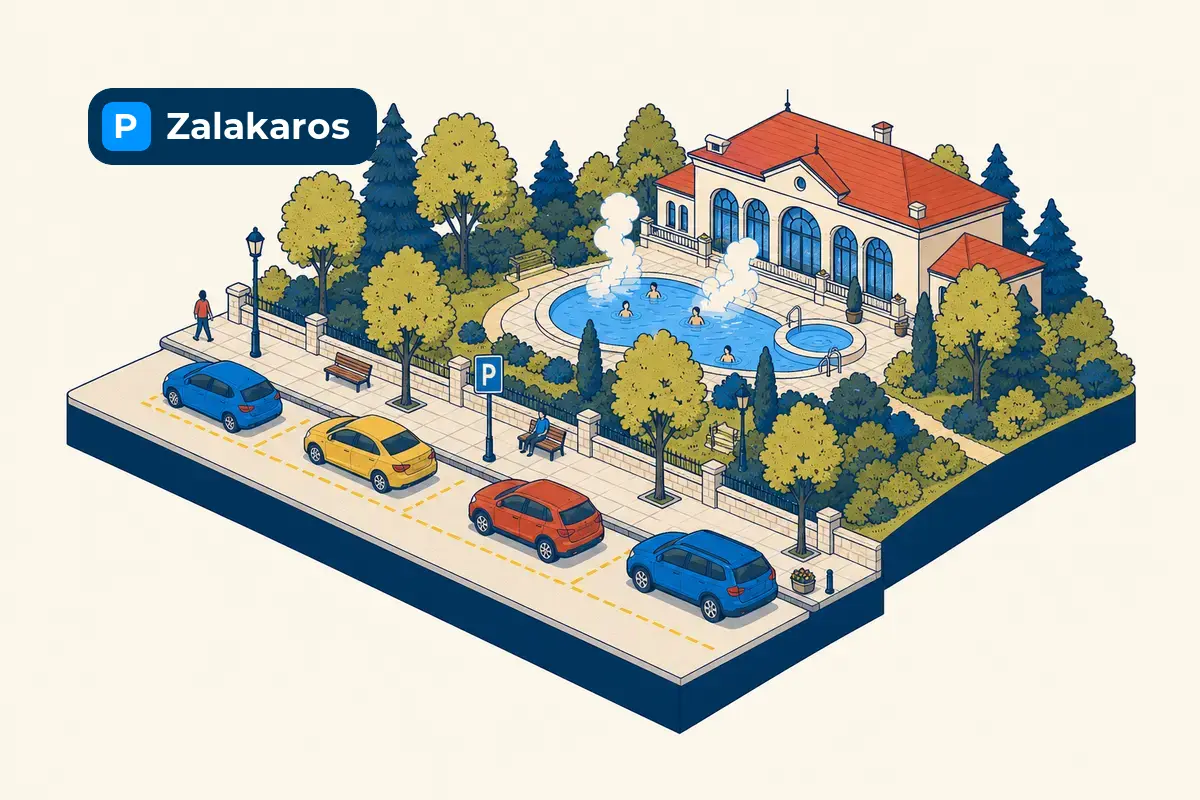
There is exactly one paid parking zone in Zalakaros. Parking fees apply every day in the paid zone, so remember that they are payable on weekends and public holidays too. If you are arriving by car, check the parking rules on site and make sure to pay when you start parking.
Mobile parking is a convenient option if you do not want to look for a parking meter: you can start your parking session from your phone. You can find the latest local information on the Zalakaros parking page.
Paid zone details: 8749 – Zalakaros Zone 1, HUF 400/hour (daily, 09:00–18:00).
The fees are based on data from the National Mobile Payment Plc. and were valid at the time this article was published.
Tip: If you are unsure whether your parking spot is in the paid zone, check the zone finder. When visiting the spa, remember that parking fees apply on weekends and public holidays too.
Once you have parked, you can start your parking session on site from your phone in just a few clicks, without a meter, cash or installing an app.
The above information is for informational purposes only and may differ from the actual data in certain cases. To view the current daily parking fees, please click the link below!
ZALAKAROS Parking zone information: 10-27-2026